Dispatch
Most crooked houses in Amsterdam
Amsterdam is famous for its picturesque canals, historic architecture, and charming narrow houses. Among the city’s most fascinating features are its leaning buildings, which have become a unique symbol of Amsterdam’s past. Some of these tilted structures were caused by unstable ground, while others were designed with practical purposes in mind. Here are five remarkable crooked buildings and locations worth discovering.
Theodore Langford
Rider
Desk note
Full dispatch and transfer tips sit below.
Line
Blue Line Walk
Amsterdam is famous for its picturesque canals, historic architecture, and charming narrow houses. Among the city’s most fascinating features are its leaning buildings, which have become a unique symbol of Amsterdam’s past. Some of these tilted structures were caused by unstable ground, while others were designed with practical purposes in mind. Here are five remarkable crooked buildings and locations worth discovering.
Vijzelgracht
The construction of Amsterdam’s underground North-South metro line became one of the city’s most challenging infrastructure projects, taking much longer and costing far more than originally expected. Unfortunately, the work also created problems for nearby historic buildings.
Between 2008 and 2012, several 17th-century houses along Vijzelgracht began sinking by approximately 15 to 23 centimeters due to construction-related ground movement. As a result, some residents had to temporarily move out while repairs and safety measures were carried out.
The affected historic houses at Vijzelgracht 4-10 and 20-26 remain a reminder of the difficulties involved in balancing modern development with Amsterdam’s centuries-old architecture.
Sluyswacht
Sluyswacht is one of Amsterdam’s most recognizable leaning buildings. This charming wooden house was constructed in 1695 as a residence for a lock keeper and stands directly across from the Rembrandt House Museum.
The building’s noticeable tilt gives it a unique character, making it one of the city’s most photographed houses. When artist Rembrandt lived nearby, he even painted an image of the lock located in front of the house.
In recent decades, Sluyswacht has operated as a cozy café, allowing visitors to enjoy its historic atmosphere while experiencing one of Amsterdam’s most unusual architectural landmarks.
Location: Jodenbreestraat 1
The Dancing Houses
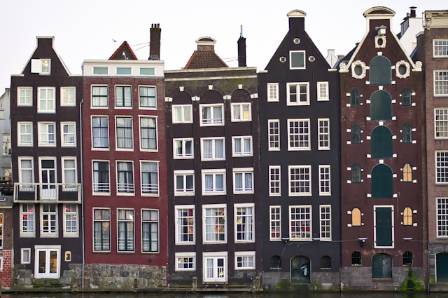
Known as the “Dancing Houses,” these canal-side buildings appear to lean toward one another as if they are moving together in a playful dance. Their unusual appearance may seem amusing, but the reason behind their tilted positions is closely connected to Amsterdam’s challenging foundation conditions.
Many historic buildings in the city were constructed on soft, marshy ground supported by wooden piles. Over time, these foundations shifted, causing some houses to sink or lean at different angles.
The result is a row of charming buildings that seem to sway together along the canal, creating one of Amsterdam’s most iconic and photographed scenes.
Location: Amstel 100-112
Rokin
The buildings along Rokin have a fascinating history connected to the changing landscape of Amsterdam. This area was once located beside the water, but the final section of the Amstel River was filled in during the 1930s, transforming the area into a street.
The building at Rokin 116 originally housed businesses such as a Persian carpet shop and an art dealer. In 2003, when the property was vacant, it was occupied illegally twice within the same year.
Although the building has since been restored, it has kept its distinctive crooked appearance, preserving a piece of Amsterdam’s unusual architectural character.
Location: Rokin 116
Spiegelgracht
Spiegelgracht is a small but charming canal street located opposite the Rijksmuseum and is known for its art galleries, antique shops, jewelry stores, and historic buildings.
One of its most interesting structures is a narrow house with a traditional clock gable that appears to lean comfortably against its neighbor. This type of design was common among Amsterdam’s canal houses, as many were intentionally built with slightly forward-leaning facades.
The forward angle helped protect the front walls while allowing residents to lift heavy goods through attic windows using exterior hoists. Today, these tilted houses remain an important part of Amsterdam’s historic charm and architectural identity.
Nearby stops
 STOP
· en
5 Most Beautiful Hikes
Jasmine
 STOP
· en
How to Design a Flower in a Geometric Style
Blair Mercer
 STOP
· en
Ideas for Styling One Belt with Multiple Outfits
Celia Blythe
 STOP
· en
Realistic Watercolor Otter Guide
Samuel Hayes
 STOP
· en
Nature’s Optical Illusion: The Copperband Butterflyfish
Henry Jackson
 STOP
· en
The Biggest Palaces Ever Built
Briar Lennox