← Back to desk5 min ride
Dispatch
The 7 Best British Castles with Moats
Moats have long symbolized both power and protection in castle design. In medieval Britain, these watery barriers were more than just scenic features — they served as vital lines of defense against siege warfare, and later evolved into elegant ornamental features for grand estates. From the vast fortresses of Wales to the romantic strongholds of Kent, here are seven of the most remarkable moated castles in Britain.
A
Ava Mitchell
Rider
Desk note
Full dispatch and transfer tips sit below.
Line
Blue Line Walk
Moats have long symbolized both power and protection in castle design. In medieval Britain, these watery barriers were more than just scenic features — they served as vital lines of defense against siege warfare, and later evolved into elegant ornamental features for grand estates. From the vast fortresses of Wales to the romantic strongholds of Kent, here are seven of the most remarkable moated castles in Britain.
1. Caerphilly Castle – South Wales
Caerphilly Castle is one of the largest fortresses in the United Kingdom and boasts perhaps the most elaborate water defenses of any castle in Britain. Built beginning in 1268 by Gilbert de Clare, a Norman lord determined to assert control over South Wales, it occupies a natural gravel bank in a broad valley. The castle’s ingenious system of artificial lakes and moats made it nearly impregnable, protecting its concentric walls and corner towers from siege engines and attackers.
The surrounding waters are not merely decorative — they were a key part of the defensive design, reflecting the power and wealth of its builder. Though the castle suffered damage during the English Civil War, including the famous “leaning tower,” it remains a dramatic example of medieval military architecture at its most ambitious.
2. Beaumaris Castle – Anglesey, Wales
Beaumaris Castle is often hailed as the “perfect” example of medieval fortification. Begun in 1295 by King Edward I as part of his campaign to dominate Wales, it represents the final and most sophisticated design in his famous “Iron Ring” of castles. Although never completed, Beaumaris displays exquisite geometric symmetry — a concentric plan with massive walls surrounded by a broad moat that draws water directly from the nearby Menai Strait.
Its moat was both functional and symbolic: it protected the castle’s sea gate, which allowed ships to deliver supplies directly inside. Even unfinished, Beaumaris has a quiet, timeless beauty. Today, its reflection in the still water of the moat captures the serene confidence of late-thirteenth-century royal power.
3. Caerlaverock Castle – Dumfries and Galloway, Scotland
Caerlaverock Castle stands out among all British fortresses for its distinctive triangular shape and near-perfect moat system. Located near the Solway Firth, the castle dates from the late 13th century and guarded the Scottish borderlands during centuries of conflict with England. Its red sandstone walls rise directly from a surrounding water-filled ditch, giving it the appearance of floating on the landscape.
In 1300, it endured a famous siege by Edward I’s army during the Wars of Scottish Independence, an event that inspired a detailed medieval account describing it as “so strong a castle that it did not fear a siege.” Though later ruined, its compact design and deep moat remain strikingly well preserved — an enduring symbol of the turbulent frontier life of medieval Scotland.
4. Bodiam Castle – East Sussex, England
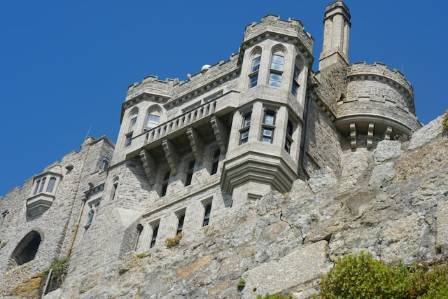
If one picture could define the idea of a “storybook castle,” it would be Bodiam. Built in the 1380s by Sir Edward Dallingridge, a former knight of Edward III, Bodiam was designed both for defense and display. Its perfect square plan, corner towers, and wide mirror-like moat were meant to impress as much as to protect. The castle was constructed at a time when England feared a French invasion during the Hundred Years’ War, yet its features were as much about prestige as military necessity.
The moat, fed by a branch of the River Rother, makes Bodiam appear to float like a vision on the water. Inside, it offered all the comforts of a grand manor, blending medieval strength with aristocratic elegance. Today, it remains one of Britain’s most photographed castles, a romantic relic of the late Middle Ages.
5. Leeds Castle – Kent, England
Set on two small islands in the River Len, Leeds Castle has been described as “the loveliest castle in the world.” Its origins stretch back to the 12th century, when it was built by Robert de Crevecoeur as a Norman stronghold. The surrounding moat and water defenses made it a natural fortress, and by the 13th century, it became a royal residence under King Edward I.
Leeds Castle’s history is rich with royal associations — Henry VIII famously used it as a palace for Catherine of Aragon. Over the centuries, it was transformed from medieval fortress to stately home, but the moat has always remained its most defining feature. Today, the castle’s reflection across the calm lake embodies centuries of English heritage, from chivalric grandeur to Tudor refinement.
6. Hever Castle – Kent, England
Hever Castle is smaller and more intimate than most medieval strongholds, yet its charm and history are unmatched. Built in the 13th century and later transformed into a Tudor manor house, it was the childhood home of Anne Boleyn, the ill-fated second wife of Henry VIII. The castle’s wide moat gives it a defensive appearance, though it was always more of a fortified manor than a military fortress.
Surrounded by manicured gardens and water features, Hever combines romance with history. Inside, it holds a collection of Tudor portraits and tapestries that bring the Boleyn story vividly to life. The moat, crossed by a stone bridge, enhances the sense of isolation and secrecy that defines the castle’s atmosphere.
7. Herstmonceux Castle – East Sussex, England
Herstmonceux Castle, built in the 1440s, marks a transition from medieval fortification to Renaissance residence. One of the first major brick-built castles in England, it replaced stone with the warm red tones that were fashionable among the gentry of the 15th century. Although surrounded by a wide moat, Herstmonceux was never intended for warfare; it was a display of taste, wealth, and innovation.
Its symmetrical design, tall towers, and flower-filled gardens make it more palatial than defensive. Over time, it has served as a family estate, a wartime observatory, and an academic center. Today, it symbolizes the evolution of the castle from fortress to country home, where the moat serves not to keep enemies out but to frame beauty within.
The Legacy of Britain’s Moated Castles
Across the British Isles, moated castles represent the changing face of power and architecture. From Caerphilly’s vast defenses to Hever’s intimate charm, each reflects a different moment in history — when water meant security, status, and spectacle. Today, these castles remain as much symbols of endurance as they are windows into Britain’s medieval imagination, their mirrored reflections continuing to captivate travelers centuries later.
Nearby stops
 STOP
· en
We Tasted 10 Flavored Sparkling Water Brands and This Is the Best
Lachlan Merritt
 STOP
· en
Realistic Watercolor Otter Guide
Samuel Hayes
 STOP
· en
Mastering the Depths: A Comprehensive Guide to Underwater Art
Stephen Andrew Thornton
 STOP
· en
The Last Wild Horse of the Steppes
Vesper Lane
 STOP
· en
The Only Closet Decluttering Rule You Really Need
Alton Reeves
 STOP
· en
Creamy Mushroom Risotto
Jordan Blake